

What Is a Single Action OTF Knife?

Short answer
A single action OTF knife is an out-the-front automatic knife that fires the blade forward with the switch, then requires a separate manual reset or re-cocking
In this article
- 01 How a single action OTF knife works
- 02 What “single action” means mechanically
- 03 Single action vs double action OTF
- 04 Common reset methods
- 05 1. Rear charging handle or pull piece
- 06 2. Pull knob or cocking knob
- 07 3. Chassis-access or break-open reset
- 08 Concrete mechanism examples that make the definition clearer
- 09 Common misunderstandings
- 10 “Single action means the knife only opens once.”
- 11 “Single action means lower quality.”
- 12 “All OTF knives retract with the same switch.”
- 13 “If it needs manual reset, it is malfunctioning.”
- 14 Why the distinction matters
- 15 Quick FAQ
- 16 What is a single action OTF knife in plain English?
- 17 Does a single action OTF retract automatically?
- 18 What is the main difference between single action and double action OTF knives?
- 19 How can I identify one from a product description?
- 20 Is a single action OTF still an automatic knife?
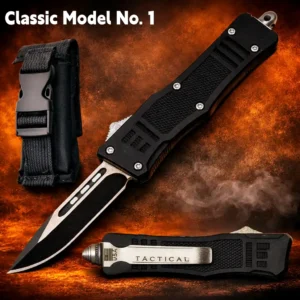
A single action OTF knife is an out-the-front automatic knife whose actuator does one powered job only: it launches the blade forward. It does not pull the blade back in through that same control. After deployment, the knife must be manually reset or re-cocked before it can fire again.
The shortest accurate definition is: automatic out, manual reset back.
How a single action OTF knife works
The mechanism stores spring tension inside the handle while the knife is in its cocked state. Pressing the button or release actuator frees that stored energy, and the blade travels straight out the front of the handle until it locks open.
At that point, the spring has already spent its energy. Unlike a double action OTF, the same switch does not reverse the process. The user has to re-cock the mechanism by hand so the spring is under tension again for the next deployment.
That operating cycle usually looks like this:
- Cocked: the internal spring is tensioned and the blade is retained inside the handle.
- Released: the actuator trips the sear or release point.
- Deployed: the spring drives the blade forward out the front.
- Locked open: the blade remains open for use.
- Manually reset: the user re-cocks the internal carrier or spring system for the next firing cycle.
The key detail is that the actuator is primarily a release, not a two-way control.
What “single action” means mechanically
In knife terminology, single action refers to the fact that the powered mechanism acts in one direction only: deployment. Retraction or re-cocking is separate. That is why a single action OTF can still be fully automatic in how it opens, even though it is not automatic in how it resets.
This is different from a side-opening automatic knife, where the blade usually closes manually on a pivot. On a single action OTF, the blade path is linear, but the one-way powered cycle is the same idea: the spring is used for opening, not for both directions.
Single action vs double action OTF
| Feature | Single Action OTF | Double Action OTF |
|---|---|---|
| Powered movement | Blade deploys automatically only | Blade deploys and retracts through the same slider |
| Actuator role | Release control | Two-way operating control |
| After firing | Must be manually reset or re-cocked | Can usually be retracted immediately with the slider |
| User experience | More specialized, more mechanical involvement | More straightforward for repeated open-close use |
| Typical mechanism layout | Spring-driven launch with separate charging step | Slider-linked carriage that tensions and reverses the spring system |
If you only need the practical distinction, it is this: a single action OTF fires with the switch but does not retract with it; a double action OTF does both.
Common reset methods
“Manual reset” can sound vague, but in real products it usually follows a few recognizable patterns.
1. Rear charging handle or pull piece
One common design uses a charging piece at the butt end of the handle. After the blade has fired, the user pulls that rear piece until the internal carrier catches again. This style is easy to identify because the reset control is visually separate from the firing button.
2. Pull knob or cocking knob
Some single action OTFs use a small external knob, ring, or stud connected to the internal mechanism. Pulling it back re-cocks the spring. This is mechanically similar to charging a launcher: the firing button releases the stored energy, while the knob prepares the next cycle.
3. Chassis-access or break-open reset
A less common family uses a frame or chassis movement to reset the mechanism. Instead of pulling a rear charging piece, the user manipulates part of the handle assembly to return the blade carrier to its ready position. These designs are more specialized, but they still qualify as single action because the actuator itself only handles the release.
These examples matter because “single action” does not describe just one exact hardware layout. It describes the operating logic: one control fires the blade, and a separate step prepares the mechanism again.
Concrete mechanism examples that make the definition clearer
Two design cues are especially helpful when identifying a single action OTF:
- A dedicated firing button paired with a separate charging control: if the knife has one control to launch and another to re-cock, that is a classic single action pattern.
- A release-first mechanism rather than a continuous slider track: single action OTFs typically feel like a stored-energy release, while double action OTFs usually feel like the slider is actively managing both directions.
In other words, a single action OTF often behaves more like a spring-powered launch system with a reset stage, whereas a double action OTF behaves more like a two-way carriage system controlled by the slider.
That distinction is useful because many product listings simply say “OTF automatic” without clearly explaining whether the knife is single or double action.
Common misunderstandings
“Single action means the knife only opens once.”
No. It means one press gives you one automatic deployment. The knife can be used again after it is manually reset.
“Single action means lower quality.”
No. The term describes the mechanism type, not the build quality, lock strength, fit and finish, or materials.
“All OTF knives retract with the same switch.”
No. That is true of double action OTF knives, not single action models.
“If it needs manual reset, it is malfunctioning.”
No. On a true single action OTF, manual re-cocking is normal operation by design.
Why the distinction matters
For most readers, the reason to know this term is simple: it changes how the knife is operated. A person expecting a double action OTF may assume the blade will retract by moving the same slider or button back. On a single action OTF, that expectation is wrong. The knife must be reset through its specific charging method.
That is also why single action and double action should not be treated as minor variations. They are different mechanism families with different handling, different internal layouts, and different user expectations.
If you are comparing models in an OTF automatic knife catalog, this is one of the first specifications worth confirming.
Quick FAQ
What is a single action OTF knife in plain English?
It is an automatic out-the-front knife that shoots the blade forward with its switch, then needs a separate manual reset before it can fire again.
Does a single action OTF retract automatically?
Not through the same actuator. It requires a separate reset or re-cocking step.
What is the main difference between single action and double action OTF knives?
Single action powers deployment only. Double action powers both deployment and retraction through the same control.
How can I identify one from a product description?
Look for terms like manual reset, re-cock, charging handle, or single action. If the listing says the same slider extends and retracts the blade, it is double action.
Is a single action OTF still an automatic knife?
Yes. It is automatic because the blade deploys by stored spring energy when the actuator is pressed.
Laws on automatic and OTF knives vary by jurisdiction. Check the rules that apply where you live, carry, buy, or sell.