

How a Double Action OTF Knife Deploys and Retracts

Short answer
A double-action OTF knife uses one thumb slider to both open and retract the blade by moving an internal carrier that engages the blade tang, loads spring tensi
In this article
- 01 Key parts that make the mechanism work
- 02 How opening works, step by step
- 03 How closing works, step by step
- 04 A concrete example of a typical double-action OTF layout
- 05 How double-action differs from single-action OTF
- 06 Quick checklist: how to identify a true double-action OTF
- 07 What “off-track” means and why it happens
- 08 Common misconceptions
- 09 Your thumb powers the whole blade movement
- 10 There is one simple spring always pushing the same way
- 11 If the blade stops short once, the knife is broken
- 12 Why the slider feels different from other automatics
- 13 Concise FAQ
- 14 Does a double-action OTF lock both open and closed?
- 15 What is the easiest real-world cue that it is truly double action?
- 16 Why can two double-action OTF knives feel different if they work on the same principle?
A double-action OTF knife deploys and retracts with the same thumb slider: the slider moves an internal carrier that catches the blade tang, loads spring tension, then crosses a point where spring bias flips so the blade is driven the rest of the way open or closed.
In other words, your thumb does not shove the blade through its full travel. Your thumb moves the actuator and carrier through the first part of the stroke, and the mechanism hands off the last part to stored spring energy. That is why a true double-action OTF has noticeable slider resistance in both directions.
Key parts that make the mechanism work
Different makers use different spring layouts and carrier shapes, but most double-action OTFs share the same working pieces:
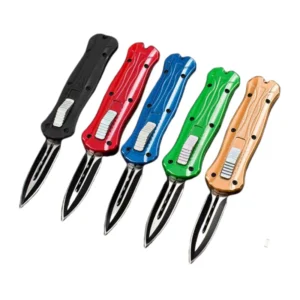
- Thumb slider: the external control you push forward to open and pull back to close.
- Carrier or shuttle: the internal sliding block linked to the thumb slider.
- Blade tang: the rear portion of the blade that the carrier hooks, pushes, or pulls during the cycle.
- Spring system: usually arranged so energy can assist travel in either direction once the carrier passes a midpoint or release threshold.
- Rails or guide channels: the surfaces that keep the blade moving straight through the handle.
- Stops and engagement faces: the points that define full-open and full-closed position.
The most important part to understand is the carrier. It is the moving link between your thumb and the blade tang. During opening, it drives the tang forward while loading spring tension. During closing, it drives the tang backward while loading spring tension in the opposite direction. Near mid-stroke, the mechanism shifts from thumb-driven movement to spring-finished movement.
How opening works, step by step
- You push the slider forward. That moves the internal carrier forward inside the handle.
- The carrier engages the blade tang. Instead of your thumb directly pushing the blade tip outward, the carrier pulls or pushes on the tang and starts moving the blade along the rails.
- The spring is loaded during this first part of travel. As the carrier moves, the mechanism stores energy. This is the resistance you feel under your thumb.
- The mechanism crosses its handoff point. At roughly the middle of the stroke, depending on design, the spring bias changes so stored energy now favors the opening direction.
- Spring force finishes the opening cycle. The blade accelerates the rest of the way until it reaches its open stop and seats in its open position.
Plain English: you are not throwing the blade out by thumb force alone. You are cocking and releasing an internal shuttle that takes the blade to the point where the spring can finish the job.
How closing works, step by step
- You pull the same slider backward. The carrier now moves in the opposite direction.
- The carrier re-engages the tang for the return stroke. It begins drawing the blade back into the handle.
- The spring is loaded again, but for closing. You feel resistance because the mechanism is once again storing energy before release.
- The carrier passes the reverse handoff point. After that threshold, spring bias now favors the closed direction.
- Spring force completes retraction. The blade is pulled fully into the handle and stops in the closed position.
This two-way cycle is what makes the design double action. One control opens the blade, and the same control retracts it, with spring-assisted completion in both directions.
A concrete example of a typical double-action OTF layout
On a common modern OTF layout, the thumb slider is connected to a flat carrier running in a channel under the blade. The carrier has engagement faces or hooks that catch matching surfaces on the blade tang. As you push forward, the carrier drags the tang and tensions the spring arrangement. Once the carrier passes the mechanism’s center point, the spring force no longer resists opening and instead drives the carrier and blade to the front stop. Pulling the slider back repeats the same sequence in reverse: the carrier catches the tang from the opposite side, tensions the mechanism, crosses center, and the spring finishes the blade into the handle.
Design details vary by maker. Some use different spring anchoring, tang geometry, or lockup faces. But the common pattern is the same: carrier engages tang, thumb loads the mechanism, spring bias flips near mid-stroke, spring completes travel.
How double-action differs from single-action OTF
| Feature | Double-action OTF | Single-action OTF |
|---|---|---|
| Opening | Slider opens the blade | Usually fires open from a charged spring |
| Closing | Same slider retracts the blade | Usually requires separate manual reset or charging |
| Spring role | Assists both directions after the handoff point | Primarily powers opening |
| What you feel | Resistance forward and backward | Strong release on opening, different reset feel |
The important difference is mechanical, not just user convenience. A single-action OTF does not normally use the same slider stroke to both deploy and retract through the same two-way carrier cycle.
Quick checklist: how to identify a true double-action OTF
- The same slider opens the blade when pushed forward and retracts it when pulled backward.
- You feel spring-loading resistance in both directions, not just a light return.
- The blade can be cycled open and closed without a separate charging lever, reset tab, or disassembly step.
- The action has a distinct handoff feel: your thumb starts the stroke, then the mechanism snaps through the last part.
What “off-track” means and why it happens
“Off-track” usually means the blade did not complete its normal travel to the full-open or full-closed stop. In many double-action OTFs, this happens when the blade meets resistance, the slider stroke is too weak or incomplete, or debris increases drag inside the track. The mechanism stops short instead of forcing through the obstruction.
Typical causes of incomplete travel include:
- Short-stroking the slider: not driving it firmly through the full motion.
- Obstruction at the blade path: contact with a surface or material during deployment.
- Dirt, lint, or dried lubricant: extra friction in the rails or around the tang and carrier.
- Wear or damage: less common, but possible if parts are bent, chipped, or heavily worn.
On many models, resetting is simple: return the slider fully to its start position and cycle it again with a complete stroke. If repeated failures continue after cleaning and proper operation, the issue may be wear, a weak spring, or damaged engagement surfaces.
Common misconceptions
Your thumb powers the whole blade movement
No. Your thumb powers the carrier stroke and loads the mechanism. After the carrier passes the bias point, stored spring energy finishes the blade travel.
There is one simple spring always pushing the same way
Not exactly. The mechanism is arranged so spring force can favor opening on one side of the cycle and closing on the other. The key idea is not constant one-way push, but a change in bias after the carrier crosses center.
If the blade stops short once, the knife is broken
Usually not. A partial stroke or a blocked path is a much more common reason. A true mechanical fault is possible, but it is not the first assumption.
Why the slider feels different from other automatics
A double-action OTF usually feels stiffer than a push-button side-opening automatic because the slider is doing more work. It is moving the carrier, engaging the tang, and loading the spring system through a longer stroke. A side-opening automatic often releases a spring that is already fully charged. A double-action OTF asks your thumb to charge part of the cycle every time.
Concise FAQ
Does a double-action OTF lock both open and closed?
It reaches defined open and closed positions against internal stops and engagement surfaces. Exact lockup feel depends on design and tolerances.
What is the easiest real-world cue that it is truly double action?
If one slider opens the blade forward and the same slider retracts it backward, it is operating as a double-action OTF.
Why can two double-action OTF knives feel different if they work on the same principle?
Carrier shape, tang geometry, spring strength, rail fit, and handle tolerances all affect how much resistance, snap, and blade play you feel.
For optional further reading, see the OTF automatic knife catalog. Trade buyers can also use the OTF wholesale inquiry page.