

What Is a Good Reseller Margin on OTF Knives?

Short answer
A practical guide to reseller margins on OTF knives, with landed-cost logic, QC, MOQ, packaging, sellable yield, and reorder risk for wholesale buyers.
Key Takeaways
- Start with a mild method and increase pressure or abrasion only when the blade condition requires it.
- Edge angle, steel type, corrosion level, and handle material all affect the right care method.
- For wholesale assortments, simple care instructions help customers keep knives useful longer.
Terms Used Here
- OTF
- Out-the-front; a knife design where the blade moves forward from the front of the handle.
- Fixed blade
- A knife with a blade that does not fold or retract into the handle.
- Sheath
- A protective cover used to store or carry a knife safely.
In this article
- 01 Why OTF knife margins need more room than buyers expect
- 02 A practical margin standard for wholesale OTF buying
- 03 Quick comparison standard
- 04 Example: how landed cost changes the “good margin” answer
- 05 Mistakes that shrink OTF margins fast
- 06 Counterpoint: when a lower margin can still make sense
- 07 FAQ
- 08 Should I calculate margin before or after shipping and packaging?
- 09 What MOQ is safer for a first OTF wholesale order?
- 10 Is private-label OTF usually more profitable?
A good reseller margin on OTF knives is usually a gross margin of about 40% to 60%, with 50% or better often safer once you account for defects, warranty replacements, payment fees, shipping, and slower-moving SKUs; for many wholesale buyers, anything below roughly 35% gross margin leaves too little room for real-world OTF knife costs.
How we are judging this: landed cost, sellable yield, QC consistency, repeat-order stability, and how much post-sale support the knife is likely to create. This is a market-dependent estimate, not a fixed rule, because OTF pricing changes with steel, handle material, packaging, order size, and shipping terms.
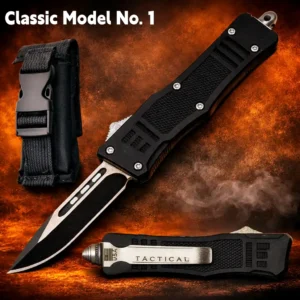
OTF knives are not a normal commodity item. The mechanism has more failure points than a simple liner lock or fixed blade: spring tension, firing button fit, track tolerances, lockup consistency, and blade play all affect sellable yield. That means a margin that looks fine on paper can disappear if 3% to 8% of a shipment needs sorting, parts, replacement, or discounting. In practice, experienced resellers often work backward from a target gross margin and then test whether the quote still works after adding packaging, inbound freight, merchant fees, and a realistic defect allowance.
Two proof cues matter here. First, cost logic: margin should be calculated on fully landed cost, not just the ex-factory or quoted unit price. Second, test method: for OTF knives, a small incoming inspection sample should check repeated deployment and retraction, button drag, misfire rate, edge symmetry, and finish consistency before you assume the full lot is sellable.
Why OTF knife margins need more room than buyers expect
Many new resellers focus on the quoted unit cost and compare it to a planned retail price. That is too shallow for OTF knives. A better question is: What percentage of this shipment will be sellable at full price after inspection, repacking, and customer service?
OTF-specific mechanism detail matters. An out-the-front knife uses an internal drive system that launches and retracts the blade on a track, usually with a spring and sear arrangement controlled by a thumb slider. Small tolerance issues can show up as intermittent failure to fire, uneven blade seating, or excessive side-to-side movement. None of those problems are theoretical to a reseller; they directly affect returns, replacement rates, and review quality.
That is why a healthy margin on OTF knives has to cover more than markup. It has to cover:
- MOQ pressure: lower MOQs often mean higher unit cost, while larger runs reduce cost but increase inventory risk.
- Lead time risk: if a supplier needs 30 to 60 days, you may need margin room to hold buffer stock.
- Sample policy: paying for pre-production or approval samples can be minor on one order but meaningful on small private-label runs.
- QC sorting: even acceptable lots may need button feel checks, blade centering review, and cosmetic grading.
- Packaging: plain white box, retail-ready gift box, nylon sheath, barcode labels, and warning inserts all change the quote.
- Repeat order stability: a low first quote is less useful if the next batch changes hardware finish, spring feel, or packaging dimensions.
Judgment call: if you are selling budget OTF knives into a price-sensitive channel, you generally need the higher end of the margin range because returns and customer questions can eat profit faster than on a simpler knife category.
A practical margin standard for wholesale OTF buying
The cleanest way to judge a quote is to compare gross margin bands against buyer risk. The ranges below are broad bands with assumptions, not hard market facts.
- Below 35% gross margin: usually thin for OTF unless defects are very low, shipping is favorable, and you have a fast-turning sales channel.
- 35% to 45% gross margin: workable for established resellers with tight QC, predictable reorders, and low packaging overhead.
- 40% to 60% gross margin: commonly the practical target band for many wholesale buyers.
- Above 60% gross margin: possible on private-label, exclusive configurations, or strong retail positioning, but not guaranteed and often tied to lower volume or more branding work.
What is included in this margin logic: unit cost, packaging quoted by the supplier, inbound freight or delivered shipping, payment costs, inspection loss, and a modest allowance for returns or replacements. What changes the band: steel grade, handle material, finish complexity, custom logo work, box type, sheath inclusion, shipping term, and order quantity.
Quick comparison standard
- Start with landed cost per unit. Include product, packaging, freight, duties if applicable, and payment fees.
- Estimate sellable yield. If you buy 500 pieces and expect 470 to 490 full-price sellable units, use that reality in your math.
- Set a replacement reserve. OTF knives can generate more after-sale handling than simpler knives.
- Check reorder stability. A good margin on batch one is less valuable if batch two changes materials or action feel.
- Compare margin by channel. Marketplace, dealer, and private-label channels each absorb margin differently.
For buyers comparing options, a wholesale OTF knife catalog is most useful when the quote clearly states what is included: box type, blade steel, handle material, logo cost, defect allowance, and shipping term.
Example: how landed cost changes the “good margin” answer
Suppose a reseller receives a broad quote band for a mid-range OTF knife. This is only an illustrative example, not a market fact.
- Quoted knife cost: $22 per unit
- Retail box and barcode label: $1.20 per unit
- Inbound freight and handling: $2.30 per unit
- Payment and admin burden: $0.80 per unit
- Estimated QC/replacement reserve: $1.70 per unit
That puts the practical landed-and-supported cost near $28 per unit. If the reseller plans to retail at $49.99, the gross margin is around 44%. That can work, but only if sell-through is steady and returns stay controlled. If the same knife retails at $59.99, gross margin rises to about 53%, which is usually more comfortable for OTF resale.
This is why buyers should not chase the lowest quote blindly. A lower quote with plain packaging, no spare parts support, inconsistent finish, or slower lead times may produce a worse real margin than a slightly higher quote with better repeatability. Observable cues matter more than vague claims of premium quality. Ask for specifics such as:
- Deployment consistency across a sample lot
- Blade finish uniformity under normal light
- Button travel feel and resistance
- Lockup consistency and typical blade play range
- Packaging count, carton protection, and labeling format
- Whether the supplier prices include replacement units, extra springs, or any defect allowance
Mistakes that shrink OTF margins fast
The most common margin mistake is using the supplier quote as if it were your cost. On OTF knives, that is rarely the full picture.
- Ignoring sellable yield: if 5% of units become B-grade or need extra handling, your margin changes immediately.
- Underpricing private-label packaging: custom boxes, foam inserts, sleeves, and logo setup can erase expected profit on smaller MOQs.
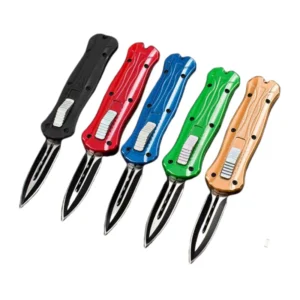
- Buying too many variants too early: color and blade-finish variety sounds attractive, but mixed slow sellers trap cash.
- Skipping sample review: one approved sample does not guarantee batch consistency, but skipping samples increases risk even more.
- Not defining QC standards in writing: acceptable blade play, finish tolerance, and cosmetic grading should not be left vague.
- Forgetting repeat-order risk: if the next production run changes hardware, clip tension, or action feel, your retail listing and return rate may suffer.
A practical sourcing note: if you are comparing suppliers, ask the same quote structure from each one. Include MOQ, lead time, sample charge, packaging details, shipping term, and any stated defect handling. If you need a structured way to gather those details, an OTF bulk inquiry form is useful only if it forces line-by-line quote comparisons instead of a single headline price.
Counterpoint: when a lower margin can still make sense
There are cases where a margin below the ideal band is still rational. If you have a high-volume channel, low customer acquisition cost, proven low return rates, and a supplier with stable reorders, a 35% to 40% gross margin may be acceptable. That is especially true if the knife is a traffic-driving SKU that helps sell accessories or higher-margin items.
The limitation is simple: thin margin leaves little room for surprises. OTF knives are more sensitive than simpler knife formats to mechanism inconsistency, shipping damage, and customer expectation mismatch. So while a lower margin can work, it is usually a deliberate strategy, not the default safe target.
FAQ
Should I calculate margin before or after shipping and packaging?
For OTF knives, judge margin after shipping, packaging, and a realistic QC allowance. That is the more useful commercial number.
What MOQ is safer for a first OTF wholesale order?
That depends on your channel, but a smaller MOQ is often safer for the first order if it lets you test sellable yield, packaging quality, and reorder consistency before committing to a larger run.
Is private-label OTF usually more profitable?
Often yes, but only if volume is high enough to spread setup costs and if repeat orders stay consistent. Private-label can improve margin, but it also increases packaging, approval, and inventory complexity.