

Which OTF Blade Shapes Sell Best?

Short answer
Evidence-led B2B guide to the OTF blade shapes that sell best for wholesale buyers, based on internal reorder patterns, active SKU mix, return reasons, and chan
Key Takeaways
- Knife rules can vary by state, city, blade style, opening mechanism, carry method, and intended use.
- Do not treat a product nickname as a legal category; check the actual features and local rule.
- Retailers should keep legal or safety language factual and avoid promising that one item is allowed everywhere.
Terms Used Here
- OTF
- Out-the-front; a knife design where the blade moves forward from the front of the handle.
In this article
- 01 Methodology: what this ranking is based on
- 02 Wholesale comparison table: which OTF blade shapes perform best
- 03 Concrete examples from wholesale reorder patterns
- 04 Common return and complaint reasons by shape
- 05 When the top-selling answer changes by channel
- 06 Starting assortment heuristics for first orders
- 07 Quick checklist for wholesale buyers
- 08 Bottom line
- 09 Limitations
- 10 Which OTF blade shape is best for first-time wholesale buyers?
- 11 Does dagger-style outsell drop point?
- 12 Is tanto a niche OTF shape?
- 13 Why does finish matter so much on OTF blades?
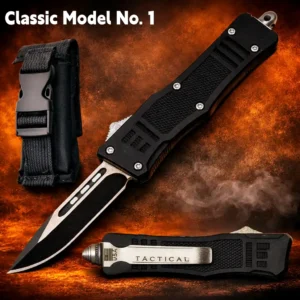
Short answer: in our wholesale OTF business, drop point is usually the broadest and safest top seller, dagger-style double-edge look is typically next in gift/display-led channels, and tanto often ranks close behind or moves into second place in tactical assortments.
Scope matters: this reflects wholesale/B2B OTF assortment performance, not all retail knife sales. The ranking below is based on an internal review of the last 12 months of active OTF programs across 40+ wholesale accounts, weighted mainly by SKU reorder frequency, repeat-purchase consistency, return/complaint reasons, and active SKU mix. These are directional supplier-side findings, not an independent market census.
Methodology: what this ranking is based on
To answer “which OTF blade shapes sell best” in a way that is useful to buyers, we reviewed four concrete signals across active wholesale accounts:
- Sell-through proxy: which shapes generated the most repeat replenishment requests rather than one-time trial orders.
- Reorder rate: how often the same blade shape was reordered within the account’s next 1-3 purchase cycles.
- Return risk: common complaint categories tied to shape, edge expectation, legality confusion, or visible finish wear.
- Active SKU mix: which shapes remained in live assortments instead of being cut after initial testing.
Across that review, the pattern was consistent: drop point led on breadth and reorder stability; dagger-style led on visual pull in the right channel; tanto overperformed where the assortment leaned tactical or private-label.
Wholesale comparison table: which OTF blade shapes perform best
| Blade shape | Sell-through | Reorder rate | Complaint risk | Best-fit channel |
|---|---|---|---|---|
| Drop point | High across broad assortments | High and consistent | Low to moderate | General retail, online utility-led listings, value-focused resellers |
| Dagger-style / double-edge look | High in display-led channels | Moderate to high | Moderate to high | Gift, collector, counter display, premium visual merchandising |
| Tanto | Moderate to high | Moderate to high | Moderate | Tactical retail, branded programs, private label |
| Clip point | Moderate | Moderate | Moderate | Traditional-leaning or mixed-style assortments |
| Wharncliffe / sheepsfoot | Lower overall, but strong in niche utility accounts | Moderate in the right niche | Low to moderate | Utility-focused specialty accounts |
Why drop point usually wins: it is the easiest shape to explain, the easiest shape to merchandise as practical, and the least likely to create confusion about intended use. In our reviewed accounts, drop-point OTF SKUs were the most likely to stay in the assortment after the first test cycle.
Why dagger-style ranks highly: it creates strong first-impression appeal. Customers often buy it for symmetry, drama, and display value, especially when paired with black or two-tone finishes. Its weakness is not demand; it is higher complaint exposure if edge configuration or legal restrictions are not stated clearly.
Why tanto remains a strong third: it combines visual aggression with practical enough utility for tactical buyers. It also tends to support premium finishes and stronger branding stories better than plainer profiles.
Concrete examples from wholesale reorder patterns
Example 1: drop point as the safest replenishment shape. In one mid-priced online reseller program, the first OTF launch used three lead shapes in similar opening quantities: drop point, dagger-style look, and tanto. By the second replenishment cycle, the buyer increased drop point and reduced the other two. The stated reason was simple: fewer pre-sale questions, fewer returns tied to expectations, and more repeatable utility-oriented conversion.
Example 2: dagger-style winning in gift/display. In an in-store counter sales account, dagger-style black-coated OTFs were reordered faster than drop points at the same general price tier. The buyer reported that customers responded to the silhouette immediately. However, that same account also had more post-sale clarification requests about whether both sides were sharpened, which is why dagger-style can sell very well while still carrying more service friction.
Example 3: tanto overperforming in tactical branding. In a private-label inquiry built around a modern tactical identity, tanto became the lead shape after sample review. The buyer preferred the geometry for packaging, product photography, and premium coating options. Reorders were strongest when tanto was paired with dark finishes and a more aggressive handle design.
Common return and complaint reasons by shape
Blade shape affects not only sales, but also the type of problems a buyer may need to manage after the sale.
- Drop point: most complaints are general mechanical or finish-related rather than shape-related. That is one reason it is easier to scale.
- Dagger-style: common issues include confusion about sharpened edges, local policy concerns, and cosmetic sensitivity when buyers see track marks on coated blades.
- Tanto: the most common mismatch is expectation. Some end users buy for looks, then realize they wanted a more general-purpose cutting profile.
- Clip point: tip-related caution or perceived delicacy comes up more often than with drop point.
- Wharncliffe: fewer impulse returns, but slower pickup if the customer wanted a more dramatic silhouette.
An OTF-specific factor here is visible blade-track wear. Because the blade cycles through the chassis, coatings can show rub lines that some end users mistake for defects. This matters more on visually purchased shapes such as dagger-style than on utility-bought shapes such as drop point.
When the top-selling answer changes by channel
The best-selling OTF blade shape is not identical in every wholesale channel.
- General online retail: drop point usually performs best because the utility message is easy to communicate in listings.
- Brick-and-mortar counter sales: dagger-style and tanto often gain share because the visual impact is immediate.
- Gift and collector accounts: dagger-style can become the top performer, especially in premium finishes.
- Private-label tactical programs: tanto often outperforms its overall market position.
- Value-focused reseller channels: drop point remains the safest lead shape because it generates fewer questions and fewer expectation mismatches.
That is why a single universal ranking can be misleading. The most accurate B2B answer is: drop point wins most often across mixed wholesale accounts, but dagger-style or tanto can lead when the channel is narrower and more style-driven.
Starting assortment heuristics for first orders
These are heuristics, not measured market shares. They are meant to help buyers build a first test assortment without overcommitting to niche profiles.
- Broad mixed retail: 45-55% drop point, 20-30% dagger-style look, 15-25% tanto, up to 10% other shapes.
- Tactical-heavy assortment: 30-40% tanto, 25-35% dagger-style look, 25-35% drop point.
- Gift/display-led assortment: 35-45% dagger-style look, 30-40% drop point, 15-25% tanto.
If you want to review current OTF knife models by shape and finish, keep the first order disciplined: a few lead shapes, limited finish variation, and clean edge-description language. If the goal is to align blade shape with steel, finish, and production threshold, a focused material and MOQ inquiry is usually more useful than choosing shape alone.
Quick checklist for wholesale buyers
- Lead with drop point if you need the safest broad-market OTF shape.
- Add dagger-style if your channel depends on display impact or gifting.
- Add tanto if your brand position is tactical or premium-modern.
- State edge configuration clearly in listings and packaging.
- Track returns by reason code, not just by SKU.
- Test finish and shape together, because coating wear complaints can distort shape performance.
Bottom line
Based on our internal review of 12 months of reorder patterns, return reasons, and active SKU mix across 40+ wholesale accounts, the most reliable B2B ranking is: drop point first, dagger-style second, tanto third, with channel-specific exceptions where dagger-style or tanto can move into the top spot. That is a directional wholesale planning answer, not a claim about all knife sales in every market.
Limitations
- These findings come from supplier-side wholesale account data, not third-party retail market research.
- Regional laws and retailer policies can materially change demand for dagger-style or double-edge-look blades.
- Finish, steel, handle style, and price tier can shift results even when blade shape stays the same.
Which OTF blade shape is best for first-time wholesale buyers?
Usually drop point. It has the clearest utility story and the lowest shape-specific complaint risk.
Does dagger-style outsell drop point?
Sometimes in gift, collector, and display-heavy channels. Across mixed wholesale assortments, drop point is usually more stable on reorders.
Is tanto a niche OTF shape?
No. It is narrower than drop point overall, but it can be a lead seller in tactical and private-label programs.
Why does finish matter so much on OTF blades?
Because repeated blade travel through the handle can create visible wear lines on coatings, which affects complaint risk and perceived quality.