

Are OTF Knives Good for Work Use?

Short answer
OTF knives can be good for work use when the job involves frequent light cutting, glove use, and one-handed access. Learn where they fit, where they do not, and
In this article
- 01 Where OTF knives work well on the job
- 02 Where OTF knives are not the best choice
- 03 How OTF work use compares with other knife styles
- 04 How to tell if an OTF knife is a good work knife
- 05 Common buying mistakes for wholesale and resale
- 06 Bottom line for buyers
- 07 Are OTF knives good for warehouse work?
- 08 What is the biggest weakness of an OTF knife at work?
- 09 Is an OTF better than a utility knife for box cutting?
- 10 What should wholesalers look for first?
Yes, OTF knives can be good for work use, but only for the right kind of work. They fit best in jobs that involve frequent light-to-medium cutting, glove use, one-handed access, and repeated opening and closing throughout the day; they are a weaker choice for heavy prying, twisting, or dirty environments with lots of grit.
The main takeaway is simple: an OTF is a practical work knife when cutting convenience matters more than raw strength. For wholesale buyers and resellers, that means the best customers are warehouse staff, delivery drivers, maintenance teams, field technicians, and retail buyers who mostly cut cardboard, plastic wrap, tape, zip ties, insulation, and strapping.
Where OTF knives work well on the job
OTF knives solve a specific work problem: the user needs the blade ready quickly, often with one hand, while the other hand is holding material, a ladder rail, a package, or a cable bundle. That is where the format earns its place.
In plain English: an OTF knife is good for work when the knife is used often, used briefly, and put away just as often.
- Warehouse and shipping: opening cartons, trimming stretch wrap, slicing tape, cutting plastic banding carefully.
- Delivery and route work: quick package access in and out of vehicles, often while wearing gloves.
- Maintenance and install work: trimming foam, cutting cord, opening parts bags, stripping away packaging around fittings.
- Retail back-room use: repetitive light cuts where compact carry matters.
- Field service: controlled one-handed use when the other hand is stabilizing a panel or tool case.
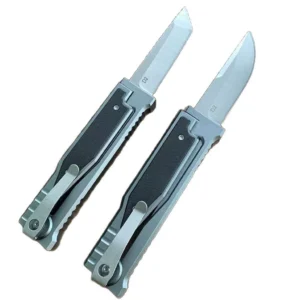
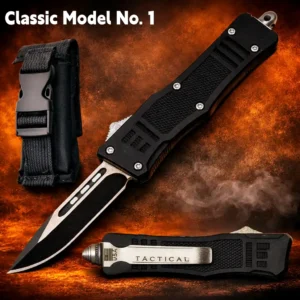
A concrete example: a technician on a ladder opens a replacement sensor box with one hand, uses the blade to cut tape and shrink wrap, retracts the blade, then climbs with both hands free. In that sequence, the named parts that matter are the thumb slider, the blade track, and the pocket clip. The OTF format helps because the user can deploy and retract without shifting grip or fumbling with a nail nick or two-handed close.
For buyers stocking OTF knife collection items, this is the core value proposition: efficient access for repeated utility cuts, not a substitute for a heavy-duty fixed blade or a thick manual work folder.
Where OTF knives are not the best choice
OTF knives are not ideal for every work site. The blade rides on an internal track and spring-driven mechanism, so the format has more moving parts than a simple lockback or liner lock folder. That does not make every OTF fragile, but it does mean the buyer should match the knife to the task instead of assuming one style covers everything.
Jobs where another knife style is usually better:
- Construction demolition: heavy cuts through dense material, scraping, twisting, and accidental side load.
- Landscaping and outdoor dirt-heavy work: constant dust, mud, sand, and plant debris can foul the action faster.
- Electrical or HVAC rough-in: tasks that tempt users to pry staples, lever covers, or twist in tight spaces.
- Processing thick rope or hose all day: a sturdier manual folder or fixed blade often gives better edge geometry and less maintenance concern.
The most common failure mode in work use is not dramatic breakage. It is misfire or incomplete deployment after lint, grit, adhesive residue, or pocket debris gets into the track. A specific buying signal is the action after repeated cycles: if the blade begins to hesitate, fail to lock fully, or feel inconsistent after ordinary cardboard duty, that model is likely a poor fit for hard-use retail positioning.
One misconception is worth clearing up: people sometimes assume an OTF is automatically a “hard-use tactical” knife because the mechanism looks advanced. For work use, the opposite buying logic is safer. Judge it as a convenience-focused cutting tool first, and only then as a durability product.
How OTF work use compares with other knife styles
For wholesale planning, it helps to compare by task instead of by hype.
- OTF knife: best for frequent short cuts, fast put-away, glove-friendly access, compact carry.
- Manual work folder: better for rougher cutting, more dirt tolerance, lower mechanism sensitivity.
- Utility knife with replaceable blade: best for high-volume cardboard and abrasive material where edge replacement matters more than carry comfort.
- Fixed blade: best for the heaviest work, wet conditions, and easy cleaning.
If the end user spends most of the day opening boxes and trimming packaging, an OTF can be a strong seller. If the end user cuts roofing felt, pries staples, or works in mud, a utility knife or fixed blade will usually create fewer returns.
Some wholesale accounts also cross-shop OTFs with personal protection items. In those cases, it is useful to separate utility demand from defensive demand and merchandise accordingly through related categories such as utility and self defense products. Buyers who keep those use cases distinct generally build cleaner assortments and reduce customer confusion.
How to tell if an OTF knife is a good work knife
Use this checklist before buying for resale, private label, or fleet-style employee issue.
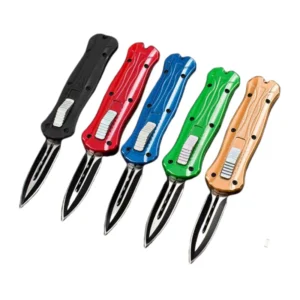
- Blade shape matches the task: drop point and tanto styles are common, but a practical utility grind with usable belly often sells better for packaging work than an extreme profile.
- Handle has secure texture: smooth aluminum can feel sleek in photos but slippery with gloves or sweat.
- Slider is easy to operate without pain: too-stiff action may reduce real-world use, especially for repeated warehouse cuts.
- Pocket clip placement supports work carry: deep enough to stay put, not so tight that it tears lighter uniform pockets.
- Mechanism resets cleanly after a misfire: this is a useful identification cue during sample inspection.
- Blade play stays within acceptable limits: a little movement is common in many OTFs; excessive rattle or side-to-side looseness is a warning sign.
- Finish resists tape adhesive and grime: coated blades can look good, but some finishes show residue quickly in carton-cutting use.
- Replacement and warranty terms are realistic: wholesale buyers should ask about springs, clips, screws, and service turnaround.
A concrete maker example helps here. A double-action OTF in the Benchmade Infidel size class may appeal to users who want a familiar premium format, but for actual work accounts, many buyers prefer a simpler, less collectible utility-oriented design with a straightforward blade shape and lower replacement cost. That is not a criticism of premium makers; it is a reminder that work knives are judged by repeat use, maintenance tolerance, and replacement economics.
Common buying mistakes for wholesale and resale
- Buying for appearance instead of task: aggressive blade shapes may photograph well but underperform on box breakdown and routine utility cuts.
- Ignoring local law and workplace policy: automatic knives can be restricted by jurisdiction, employer policy, or venue rules. This matters for distributors and fleet buyers.
- Overestimating dirt tolerance: if the customer base works around drywall dust, sand, or adhesive-heavy packaging, expect higher maintenance questions.
- Skipping sample-cycle testing: open and close sample units repeatedly, then cut cardboard, tape, and plastic wrap before approving a line.
- Treating all OTFs as the same: spring feel, track finish, button geometry, clip quality, and blade grind vary widely between factories.
- Not defining the user: a retail enthusiast, a warehouse supervisor, and a private security buyer may all ask for an OTF, but they do not need the same knife.
The most commercially useful approach is to separate OTFs into two baskets: utility-first models for work users and style-first models for collectors or impulse retail. That simple split improves merchandising, lowers mismatch complaints, and helps sales staff explain the product honestly.
Bottom line for buyers
OTF knives are good for work use when the work is mostly cutting, the user values quick access and quick closure, and the environment is not especially filthy or abusive. They are less suitable when the knife will be used as a scraper, pry bar, or all-day demolition tool.
For wholesale buyers, the winning assortment usually includes practical blade shapes, grippy handles, clips that suit uniform pockets, and pricing that makes replacement acceptable. Sell OTFs as efficient utility tools for the right jobs, not as universal hard-use knives, and customer satisfaction tends to be much stronger.
Are OTF knives good for warehouse work?
Yes, often. They are well suited to opening cartons, cutting tape, trimming wrap, and repeated short tasks where one-handed access helps.
What is the biggest weakness of an OTF knife at work?
The biggest weakness is mechanism sensitivity compared with simpler knife types. Grit, lint, and adhesive residue can cause sluggish action or misfires if the knife is not maintained.
Is an OTF better than a utility knife for box cutting?
Not always. A utility knife is usually better for very high-volume cardboard cutting because blade replacement is faster and cheaper. An OTF is better when carry comfort and quick in-and-out use matter more.
What should wholesalers look for first?
Start with blade shape, slider comfort, clip quality, and consistency after repeated cycling. Those four points usually predict whether the knife will work well in real job use.