

Which OTF Knives Are Best for Gun Stores?

Short answer
A specific B2B guide to the best OTF knives for gun stores, with recommended store archetypes, target retail bands, return-risk notes, display roles, and real m
Key Takeaways
- Knife rules can vary by state, city, blade style, opening mechanism, carry method, and intended use.
- Do not treat a product nickname as a legal category; check the actual features and local rule.
- Retailers should keep legal or safety language factual and avoid promising that one item is allowed everywhere.
Terms Used Here
- OTF
- Out-the-front; a knife design where the blade moves forward from the front of the handle.
- Automatic knife
- A knife that opens by a spring-driven mechanism after the user activates a button, switch, or slider.
- EDC
- Everyday carry; gear intended for regular daily tasks.
In this article
- 01 Recommended OTF archetypes for gun stores
- 02 What actually makes an OTF right for a gun store
- 03 Specific product examples worth knowing
- 04 1. Mid-size double-action drop-point OTF
- 05 2. Mid-size tactical tanto OTF
- 06 3. Compact OTF for lower-spend customers
- 07 4. Value-oriented workhorse lane
- 08 5. Premium showcase piece
- 09 How to build an opening assortment
- 10 Tradeoffs buyers should be honest about
- 11 Return-risk and defect screening criteria
- 12 Legal stocking note for automatic knives
- 13 Bottom line
- 14 FAQ
- 15 What is the single best OTF type for most gun stores?
- 16 Should gun stores stock premium brands first?
- 17 How many OTF SKUs should a small gun store test?
- 18 Which finish is easiest to manage in a display case?
The best OTF knives for gun stores are mid-size double-action models with 3.0 to 3.5 inch blades and realistic retail prices around $40 to $100, because that size and price band fit add-on buying, glass-case display, and everyday-carry expectations better than tiny novelty pieces or large premium showpieces.
This recommendation is based on four operator-facing criteria: carry size, target retail, visible build quality, and display behavior. In practice, the OTFs that work best in gun stores are the ones staff can demonstrate quickly, customers can picture carrying, and the case can support without tying up too much cash in slow-moving inventory.
Why this answer: the strongest store picks are not simply the cheapest or most aggressive-looking. They are the SKUs that hit a believable accessory spend, survive repeated handling, and cover distinct customer intents: core EDC, tactical look, compact carry, and one step-up piece.
Recommended OTF archetypes for gun stores
| Archetype | Target retail | Ideal customer | Margin band | Return/defect risk | Display role | Stocking priority |
|---|---|---|---|---|---|---|
| Mid-size drop-point double-action | $50-$90 | Broad EDC buyer | Moderate | Low to moderate | Core seller | Highest |
| Mid-size tanto double-action | $55-$95 | Tactical-oriented buyer | Moderate | Moderate | Second core seller | High |
| Compact EDC OTF | $40-$75 | Budget-conscious or lighter-carry customer | Moderate | Moderate | Entry lane | High |
| Premium-look full-size OTF | $90-$150 | Step-up buyer | Moderate to higher dollars per unit | Moderate to higher | Showcase piece | Medium |
| Rescue-style OTF with glass breaker | $60-$100 | Preparedness or vehicle-kit buyer | Moderate | Moderate | Utility specialist | Medium |
What actually makes an OTF right for a gun store
Gun-store traffic is different from traffic in a knife-only shop. A large share of OTF sales happen as accessory purchases alongside holsters, magazines, lights, range gear, or concealed-carry items. That changes what performs well. A 3.25 inch blade in an aluminum body usually reads as serious but still pocketable. A retail price under roughly $100 is easier to close at the counter than a $180-plus collector pitch. Neutral finishes such as black or stonewash also age better in a display case, which matters when one sample gets opened and closed all day.
There is a second practical filter: avoid features that create explanation friction. Overly decorative hardware, mirror-polished finishes, extreme serrations, and oversized bodies may attract attention, but they also produce more hesitation and more condition complaints after handling. For most gun stores, the right OTF is the one a staff member can hand over and explain in one sentence: size, blade shape, clip, and intended use.
Specific product examples worth knowing
These are not the only viable choices, but they are real model examples that illustrate the lanes gun stores usually need to cover.
1. Mid-size double-action drop-point OTF
Best for: core glass-case seller
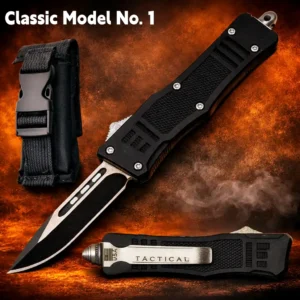
A model in the vein of the Benchmade Infidel shows why the mid-size OTF format works: familiar proportions, straightforward carry, and instant recognition among firearms customers. At the premium end, it proves the shape and size are market-tested even if many stores will stock lower-priced lookalike lanes rather than that exact MSRP tier. The key reason this format works is simple: customers understand the blade shape immediately.
2. Mid-size tactical tanto OTF
Best for: tactical-leaning accessory buyers
The Microtech Ultratech Tanto is a useful reference point because it demonstrates how a mid-size tanto OTF can look aggressive without becoming oversized. Stores that sell weapon lights, optics, and defensive accessories often need one OTF that visually matches that category language. The reason to carry this archetype is not that every buyer wants a tanto; it is that enough buyers want a more angular, tactical profile to justify one clear option.
3. Compact OTF for lower-spend customers
Best for: entry price lane
The Kershaw Livewire, while not a budget knife, is a strong example of a cleaner, slimmer carry-oriented OTF that feels more usable than novelty-small designs. For wholesale assortment planning, the lesson is that compact should still feel like a real EDC tool. The reason this lane matters is that some customers like the mechanism but do not want a bulky handle or a three-figure impulse decision.
4. Value-oriented workhorse lane
Best for: stores testing the category
The AKC F-16 is often referenced in the more affordable OTF conversation because it sits in a reachable retail bracket and gives stores a way to test turnover without jumping straight into premium pricing. The specific reason this kind of model matters is opening-order economics: it lets a store check local demand for OTFs without devoting too much case value to one category.
5. Premium showcase piece
Best for: one attention-grabber per case
The Heretic Cleric II illustrates the role of a larger, more premium-looking OTF. It is not the first SKU most gun stores should buy deep, but it shows why a showcase piece can help the whole case. One higher-end OTF gives staff a step-up option and can make the core $60 to $90 items look easier to justify by comparison.
How to build an opening assortment
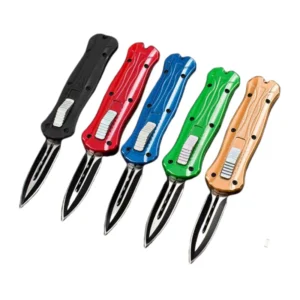
For a small or first-time test, most gun stores do not need a broad OTF wall. A practical opening mix is 4 to 6 SKUs and 6 to 12 total pieces. Start with one compact model, one mid-size drop-point, one mid-size tanto, one step-up premium-look piece, and optionally one rescue-style utility model if your store sells vehicle or preparedness gear. That mix creates visible choice without turning the case into a row of nearly identical black handles.
If you need to review available formats, sizes, and finishes, keep the product-side research separate from the editorial decision and use the catalog only as a reference point: /catalog/auto-otf-knife/.
Tradeoffs buyers should be honest about
OTF knives create strong display interest, but they are not friction-free inventory. Large statement models get handled a lot and often sell slower than expected. Very cheap OTFs can cost less up front but create more staff time around inconsistent action, lockup questions, or buyer confidence issues. Serrated and highly stylized blades may look good online yet narrow the in-store audience. Premium models can improve perceived assortment quality, but if fit and finish are inconsistent, each return is more expensive. In short, the category rewards disciplined buying more than broad buying.
Return-risk and defect screening criteria
Because OTFs are mechanism-driven products, screening matters. Before a SKU earns repeat orders, stores should pay attention to the same points customers notice in the first 30 seconds: slider effort, consistent deployment and retraction, blade centering, clip tightness, finish wear after handling, and whether the handle has sharp edges that make the knife feel cheap. Plain-edge blades usually create fewer post-sale complaints than partially serrated versions because they are easier for buyers to inspect and understand. Black and stonewashed finishes also tend to hide case wear better than bright satin.
When reordering, a simple internal scorecard helps: how many units sold at full price, how many needed extra demonstration time, how many came back for action concerns, and which blade shape got requested by name. If you need to discuss bulk quantities or pack structure after that first test, use the inquiry form as a support tool rather than as part of the buying advice: /wholesale-inquiry/.
Legal stocking note for automatic knives
OTF knives are automatic knives, and state and local rules can differ on possession, carry, age restrictions, and retail sale conditions. A model that is lawful to sell in one jurisdiction may face restrictions in another, especially around carry length, interstate shipment, or local interpretation of automatic-knife statutes. For a gun store, this is a stocking consideration as much as a legal one: compliant inventory is easier to merchandise confidently. Check current state and local rules, and if needed, have counsel or your trade association confirm what applies to your business. This article is not legal advice.
Bottom line
If a gun store wants the safest starting point, buy around the mid-size double-action OTF: one drop-point, one tanto, one compact carry model, and one higher-end visual step-up. Keep the core retail lane around $50 to $100, favor aluminum handles and plain-edge blades, and use one showcase piece to frame value rather than filling the case with oversized experiments. That mix is usually easier to explain, easier to display, and easier to reorder intelligently.
FAQ
What is the single best OTF type for most gun stores?
A mid-size double-action drop-point is the safest first SKU because it has the broadest everyday appeal and usually fits the most workable retail band.
Should gun stores stock premium brands first?
Usually not in depth. One premium example can help the display, but most stores should build the category around reachable mid-lane price points first.
How many OTF SKUs should a small gun store test?
Four to six SKUs is enough for a clean first test. More than that often creates duplicate-looking options without improving sell-through.
Which finish is easiest to manage in a display case?
Black and stonewashed finishes generally show fewer handling marks than polished finishes, so they stay presentable longer.