

Which OTF Knives Are Best for Smoke Shops?

Short answer
See which OTF knives work best in smoke shops, with a ranked shortlist, buyer criteria, return-risk tips, and practical wholesale guidance for first orders and
Key Takeaways
- Knife rules can vary by state, city, blade style, opening mechanism, carry method, and intended use.
- Do not treat a product nickname as a legal category; check the actual features and local rule.
- Retailers should keep legal or safety language factual and avoid promising that one item is allowed everywhere.
Terms Used Here
- OTF
- Out-the-front; a knife design where the blade moves forward from the front of the handle.
- EDC
- Everyday carry; gear intended for regular daily tasks.
In this article
- 01 Why this answer
- 02 What matters most when choosing OTF knives for smoke shops
- 03 Ranked shortlist: best OTF knife types for smoke shops
- 04 Compact comparison table
- 05 Two concrete SKU archetypes that fit smoke shop counters
- 06 How many OTF SKUs should a smoke shop start with?
- 07 Mistakes smoke shop buyers should avoid
- 08 Returns and complaints: where smoke shop OTF programs usually succeed or fail
- 09 First-order checklist for smoke shops
- 10 When this answer changes
- 11 FAQ
- 12 What is the safest OTF knife type for a smoke shop?
- 13 Should smoke shops begin with cheap or premium OTF knives?
- 14 Which blade shape is easiest to sell?
- 15 How many SKUs should a first order include?
- 16 What causes the most avoidable returns?
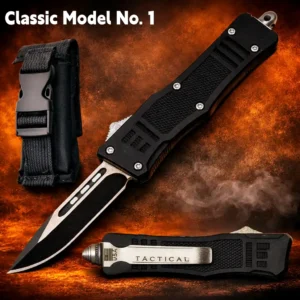
The best OTF knives for smoke shops are usually mid-size double-action models with practical blade shapes, simple handles, and retail-friendly pricing. For most stores, the safest starting point is a 3.0 to 3.3 inch drop-point or tanto OTF in black or stonewashed finishes, because it balances impulse appeal, easier staff selling, and lower return risk. That recommendation changes if your store is highly price-driven, heavily tactical, or serves more gift and EDC buyers than walk-in impulse traffic.
In smoke shop retail, the goal is not to buy the flashiest OTF. The goal is to stock knives that look good in a glass case, survive repeated handling, and sell without long explanations. Directionally, a tight assortment of 4 to 8 well-chosen SKUs often performs better than a wide mix of novelty sizes, loud colors, and oversized bodies that create display clutter and uneven sell-through.
Why this answer
This guide was built for wholesale buyers, not collectors. Inputs were reviewed in May 2026 and weighted toward smoke shop realities: counter appeal, action consistency after repeated demo cycles, likely complaint triggers, shelf-space efficiency, packaging quality, and how easily staff can explain the item in under 30 seconds. These observations are directional, not definitive market fact, because local laws, age-verification practices, and customer preferences vary by region and store format.
What matters most when choosing OTF knives for smoke shops
- Fast visual appeal: Many customers decide at the counter in 1 to 2 minutes. Clean handles and familiar finishes usually outperform busy or fantasy-heavy designs.
- Action reliability: A knife that fires cleanly through 20 to 50 open-close cycles is usually safer for retail than one that feels impressive only once.
- Practical size: Mid-size OTFs are easier to merchandise and easier to explain than oversized models or tiny novelty pieces.
- Price-to-perceived-value: The knife should look more expensive than its wholesale cost, leaving room for healthy markup without forcing a collector-only price point.
- Return resistance: Straightforward blade shapes and durable finishes usually generate fewer complaints than glossy coatings, decorative hardware, or ultra-cheap mechanisms.
- Simple assortment planning: Two body styles in two finishes is usually a better first order than 20 one-off variations.
Ranked shortlist: best OTF knife types for smoke shops
- Mid-size double-action OTF, 3.0 to 3.3 inch drop point, black or stonewashed finish
Why it ranks first: This is the best all-around smoke shop choice. It looks practical, fits most display cases, and appeals to both first-time buyers and repeat knife buyers.
Best for: General smoke shops, tobacco-accessory stores, and mixed counters with lighters, torches, and EDC gear.
Downside: It may look too plain in stores that rely on high-contrast, flashy display items. - Mid-size double-action OTF, 3.0 inch tanto, matte handle with one visual accent
Why it works: It keeps the same easy-to-stock size but adds a more tactical look. This helps stores that want one practical SKU and one sharper-looking step-up option.
Best for: Counters with tactical accessories or customers who respond to more aggressive styling.
Downside: Tanto tips can feel less familiar to casual buyers. - Compact entry-price OTF, 2.5 to 2.9 inch blade, simple alloy handle
Why it works: This is often the easiest add-on sale near the register. It works well when the knife must sit in the same mental purchase range as premium lighters or boxed accessories.
Best for: First test orders, budget-led stores, and impulse-heavy traffic.
Downside: Going too cheap can raise complaints about switch feel, spring performance, or blade play. - Premium aluminum-handle OTF with upgraded steel and cleaner packaging
Why it works: This gives smoke shops a step-up item for better-margin sales, gifting, or customers already shopping for EDC products rather than pure impulse buys.
Best for: Upscale stores, online resellers, and buyers exploring broader OTF knife buying options.
Downside: Slower turns in stores where most customers shop by price first.
Compact comparison table
| OTF type | Best use | Typical order role | Main strength | Main risk |
|---|---|---|---|---|
| 3.0-3.3 inch drop point DA OTF | Most smoke shops | Core seller | Best balance of utility and appeal | Can look basic |
| 3.0 inch tanto DA OTF | Tactical-leaning displays | Visual step-up | Stronger counter presence | Narrower taste |
| 2.5-2.9 inch entry-price OTF | Budget and add-on sales | Opening-price SKU | Lower buying risk | Higher complaint exposure if over-cheap |
| Premium aluminum OTF | EDC and gift buyers | Margin step-up | Better feel and packaging | Slower turns in value stores |
Two concrete SKU archetypes that fit smoke shop counters
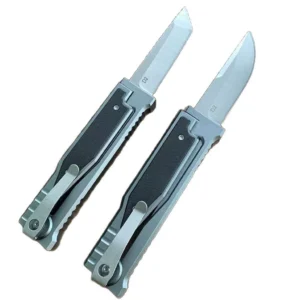
Example 1: A black 3.2 inch drop-point double-action OTF with a matte aluminum handle, plain hardware, and a basic clip is usually a strong core SKU. It fits general walk-in traffic, looks practical rather than gimmicky, and tends to be easier for staff to explain: blade length, handle material, and opening action.
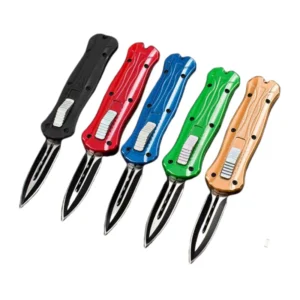
Example 2: A 2.8 inch budget OTF with a stonewashed blade and zinc-alloy handle can work as a register-adjacent add-on item. It may sell quickly if the price is accessible, but only if the switch is not overly stiff and the mechanism feels consistent through repeated handling.
A third useful setup for some stores is a two-tier display: one mid-size core OTF for broad appeal and one premium aluminum model in cleaner packaging for gifting or repeat buyers. That lets you learn whether your customers are mostly impulse-driven or willing to trade up.
How many OTF SKUs should a smoke shop start with?
For most first orders, 4 to 8 SKUs is enough. A practical setup is:
- 1 core mid-size drop-point model in 2 finishes
- 1 mid-size tanto model in 2 finishes
- Optional: 1 compact budget model in 2 finishes
That usually gives enough variety without creating dead stock. A common mistake is ordering 12 to 20 styles before learning what your customers actually pick up, ask about, and buy.
Mistakes smoke shop buyers should avoid
- Starting with oversized knives: Large OTFs attract attention but often raise more hesitation, more compliance questions, and more practicality objections.
- Buying too many finishes at once: Four colors across four body styles sounds exciting, but it often weakens reorder clarity and slows inventory turns.
- Chasing the absolute lowest cost: Saving a little on unit cost can cost more later in returns, replacements, and staff time.
- Ignoring switch feel: Customers usually test the slider before asking about steel. If it feels gritty or painfully stiff, conversion drops fast.
- Stocking only dagger profiles: Dagger blades catch attention, but drop point and tanto usually broaden the buyer pool.
- Underestimating packaging: In glass-counter retail, boxes, trays, labels, and overall presentation matter more than many first-time buyers expect.
Returns and complaints: where smoke shop OTF programs usually succeed or fail
Wholesale results with OTF knives are usually decided less by blade steel and more by early-life function and expectation setting. Directionally, the most common complaint clusters in smoke shop channels are misfires in the first few days, switch stiffness, loose screws, cosmetic wear on glossy finishes, and customer surprise about normal OTF blade movement.
A simple way to reduce returns is to explain three points at sale: the knife needs firm thumb pressure, some blade movement is normal in many OTF designs, and display handling can mark shiny finishes faster than matte ones. Many stores also reduce complaints by keeping one demo unit and selling only boxed stock. That helps prevent “used-looking out of the box” objections in high-traffic counters.
First-order checklist for smoke shops
- Start with 2 or 3 body-style archetypes, not a giant spread.
- Include one opening-price model and one stronger mid-tier model.
- Test samples through 20 to 30 open-close cycles before placing a larger order.
- Check switch tension, lockup feel, clip tightness, blade centering, and screw fit.
- Ask about replacement handling for dead-on-arrival or early misfire units.
- Use simple display cards listing blade length, handle material, and store policy notes.
- For larger mixed orders, use a bulk quote request to match pricing and assortment to your store type.
When this answer changes
- Walk-in impulse traffic: Lean toward compact and mid-size value models. Fast visual read matters more than premium steel.
- EDC-focused retailer: Shift upward into better handle materials, cleaner machining, and stronger packaging.
- Gift-heavy or premium counter: Keep one practical core SKU, but add one better-presented aluminum model for trade-up sales.
- Private-label or reseller buyer: Prioritize repeatable body shapes, packaging consistency, and lower complaint rates over broad style variety.
- Compliance-sensitive regions: Keep the assortment tighter and lead with practical, clearly described models rather than oversized or novelty-first designs.
FAQ
What is the safest OTF knife type for a smoke shop?
A mid-size double-action OTF with a 3.0 to 3.3 inch practical blade is usually the safest starting point because it balances display appeal, usability, and sell-through.
Should smoke shops begin with cheap or premium OTF knives?
Usually both: one budget-friendly model for impulse buyers and one stronger mid-tier model for customers willing to trade up.
Which blade shape is easiest to sell?
Drop point is usually the easiest for mixed retail. Tanto is a strong second choice for more tactical displays.
How many SKUs should a first order include?
For most stores, 4 to 8 SKUs is enough to test demand without overloading inventory.
What causes the most avoidable returns?
Poor action consistency, overly cheap construction, very stiff switches, and unclear customer expectations about normal OTF movement are the main avoidable issues.