

Which OTF Knives Are Best for Outdoor Stores? Ranked Picks for a Strong First Assortment

Short answer
A decisively answer-first wholesale guide to the best OTF knife types for outdoor stores, with ranked picks, concrete specs, retail price bands, store-format as
Key Takeaways
- Knife rules can vary by state, city, blade style, opening mechanism, carry method, and intended use.
- Do not treat a product nickname as a legal category; check the actual features and local rule.
- Retailers should keep legal or safety language factual and avoid promising that one item is allowed everywhere.
Terms Used Here
- OTF
- Out-the-front; a knife design where the blade moves forward from the front of the handle.
- Automatic knife
- A knife that opens by a spring-driven mechanism after the user activates a button, switch, or slider.
- EDC
- Everyday carry; gear intended for regular daily tasks.
In this article
- 01 Best OTF types for outdoor stores: ranked shortlist
- 02 1. Best overall: Mid-size single-edge drop-point OTF
- 03 2. Best entry-price: Compact clip-point or drop-point OTF
- 04 3. Best work-use: Mid-size tanto OTF with textured handle
- 05 4. Best low-maintenance display model: Stonewashed single-edge OTF
- 06 5. Best rescue add-on: Single-edge rescue OTF with glass breaker
- 07 Why this answer
- 08 Named examples buyers will recognize
- 09 Retail and wholesale price bands that actually work
- 10 Compact assortment matrix by store type
- 11 Camping or general outdoor shop
- 12 Hunting store
- 13 Marine or outfitter store
- 14 Truck-stop outdoor retail
- 15 Observable buying criteria and common return triggers
- 16 Tradeoffs outdoor stores should understand
- 17 Compliance and stocking implications
- 18 Best starting order size
- 19 FAQ
- 20 What is the single best first OTF knife type for an outdoor store?
- 21 Should outdoor stores stock double-edge OTF knives?
- 22 What retail band moves best in most outdoor stores?
- 23 Which finish is best for a heavily handled display sample?
- 24 How many OTF knives should a new outdoor retailer test first?
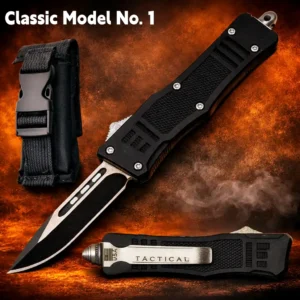
The best OTF knives for outdoor stores are mid-size, single-edge models in the 3.0 to 3.5 inch range, with one compact value option, one work-use tanto, one low-maintenance stonewashed display piece, and one rescue add-on if your store already sells vehicle or emergency gear.
The selection logic is simple and observable: carry size, blade usefulness, display durability, and retail price fit. Outdoor shoppers usually handle OTF knives in the case, judge them quickly by pocketability and action feel, and then choose the model that seems easiest to carry and easiest to explain as a real-use tool rather than a novelty.
Best OTF types for outdoor stores: ranked shortlist
1. Best overall: Mid-size single-edge drop-point OTF
Best for: most outdoor stores
Representative class: Benchmade Shootout-style field OTF or a buyer-spec equivalent built around practical carry.
Winning spec bundle: 3.2 to 3.5 inch blade, plain-edge drop point, single-edge grind, aluminum or grivory-style lightweight handle, stonewashed or matte blade, deep-carry clip.
Ideal retail band: about $79 to $149 for value-to-core imports, with premium branded field OTFs higher.
Likely buyer: campers, general outdoor customers, EDC crossover shoppers.
Main downside: less eye-catching than oversized tactical double-edge models.
Why it wins: this is the easiest OTF to sell across camping, fishing, work, and everyday carry. The blade profile is familiar, the size fits normal pockets, and staff can explain it in one sentence: it is the practical all-around option.
2. Best entry-price: Compact clip-point or drop-point OTF
Best for: first-time OTF buyers and stores testing the category
Representative class: Lightning OTF-style compact value model or a similar 3.0 inch budget-focused single-edge spec.
Winning spec bundle: 2.9 to 3.1 inch blade, plain edge, slim aluminum handle, black or bead-blast finish, standard pocket clip.
Ideal retail band: about $39 to $69.
Likely buyer: impulse buyers, younger adult customers, compact-EDC shoppers.
Main downside: lower price-point models are more likely to show variation in switch feel and finish consistency.
Why it wins: every outdoor store that carries OTF knives benefits from one clear opening-price SKU. It brings customers into the category without forcing them into a $100-plus first purchase.
3. Best work-use: Mid-size tanto OTF with textured handle
Best for: feed-store traffic, ranch/work buyers, tougher utility use
Representative class: Microtech Ultratech tanto-style format or a wholesale spec equivalent emphasizing grip and harder-use positioning.
Winning spec bundle: 3.3 to 3.5 inch tanto blade, plain edge, textured aluminum handle, low-gloss finish, secure clip.
Ideal retail band: about $89 to $169.
Likely buyer: customers cutting rope, plastic strapping, dense packaging, feed bags, and general work materials.
Main downside: the tip-forward utility story is strong, but it is less versatile for buyers who want one knife for both camp food prep and general slicing.
Why it wins: it gives your staff a true second recommendation instead of another version of the same drop-point sale. The shape creates a distinct use-case story.
4. Best low-maintenance display model: Stonewashed single-edge OTF
Best for: high-handling glass-case displays
Representative class: Kershaw Livewire-style clean-finish utility OTF or a stonewashed 3.3 inch single-edge buyer-spec model.
Winning spec bundle: 3.2 to 3.4 inch blade, drop point or clip point, stonewashed blade, matte hardware, aluminum handle, reversible or deep-carry clip.
Ideal retail band: about $79 to $159.
Likely buyer: customers who compare several knives in-hand before buying.
Main downside: subdued finishes do not pop visually as much as satin or coated contrast builds.
Why it wins: stonewash hides fingerprints, light scuffs, and tester wear better than polished finishes. For stores with one sample opened dozens of times a week, that matters.
5. Best rescue add-on: Single-edge rescue OTF with glass breaker
Best for: truck-stop outdoor sections, marine-adjacent stores, emergency-gear cross-merchandising
Representative class: Benchmade Claymore OTF rescue-style concept or a 3.3 to 3.5 inch rescue-profile spec with glass breaker.
Winning spec bundle: 3.3 to 3.5 inch blade, partially serrated or plain-edge rescue profile, corrosion-conscious finish, glass breaker, sturdy clip.
Ideal retail band: about $89 to $179.
Likely buyer: drivers, preparedness buyers, marine customers, emergency-minded shoppers.
Main downside: bulkier body and narrower audience than a standard utility OTF.
Why it wins: it works best as an add-on SKU with a second selling story beyond knife use alone.
Why this answer
These picks are based on concrete retail criteria outdoor buyers notice immediately: whether the knife fits a normal pocket, whether the blade shape is easy to explain for real tasks, whether the display sample still looks clean after repeated handling, and whether the model lands in a price band that leaves room for entry, core, and step-up sales.
Named examples buyers will recognize
If you want recognizable model families rather than abstract descriptions, the most useful benchmarks are Benchmade Shootout for lightweight field carry, Microtech Ultratech for the classic mid-size premium OTF format, Kershaw Livewire for a cleaner utility-focused single-edge profile, Lightning OTF for value-driven entry pricing, and Benchmade rescue-oriented OTF configurations as a benchmark for emergency-feature merchandising. Even if your final wholesale mix uses private-label or unbranded equivalents, those families give you real reference points for size, finish, and buyer expectation.
Retail and wholesale price bands that actually work
For most outdoor stores, the category is easiest to manage in three lanes:
- Entry: wholesale roughly $18 to $35, retail roughly $39 to $69. Best for compact single-edge models and category testing.
- Core: wholesale roughly $36 to $75, retail roughly $79 to $129. This is usually the volume lane for 3.2 to 3.5 inch practical OTFs.
- Step-up: wholesale roughly $76 to $120+, retail roughly $139 to $199+. Use this for stronger brand pull, upgraded materials, cleaner action, or rescue features.
The common mistake is overbuying the step-up lane before the core lane proves itself. In outdoor retail, one strong entry SKU, two or three core utility SKUs, and one step-up piece usually outperform a case full of near-duplicates.
Compact assortment matrix by store type
Camping or general outdoor shop
- 1 mid-size drop-point core SKU
- 1 compact entry-price SKU
- 1 stonewashed display-friendly SKU
- 1 tanto work-use SKU
Best opening count: 4 SKUs. Focus on broad use, not aggressive styling.
Hunting store
- 1 drop-point field SKU
- 1 textured tanto SKU
- 1 subdued-finish step-up SKU
Best opening count: 3 SKUs. Keep finishes muted and blade shapes practical.
Marine or outfitter store
- 1 compact corrosion-conscious carry SKU
- 1 stonewashed utility SKU
- 1 rescue add-on SKU
Best opening count: 3 SKUs. Avoid oversized tactical pieces unless they already sell in your market.
Truck-stop outdoor retail
- 1 value compact SKU
- 1 core mid-size utility SKU
- 1 rescue-feature SKU
- 1 eye-catching step-up SKU
Best opening count: 4 SKUs. This is the one format that can support one visual attention-getter without distorting the whole mix.
Observable buying criteria and common return triggers
What buyers say at the counter is usually predictable. They ask whether it is too big for pocket carry, whether the switch feels smooth, whether the blade shape is practical, and whether the clip will ride well in jeans or work pants. The return triggers tend to mirror those same points:
- Too bulky: oversized handles sell off looks, then disappoint in daily carry.
- Stiff or inconsistent action: if a tester feels rough, conversion drops and return risk rises.
- Glossy finishes age badly in the case: polished blades show handling marks fast.
- Overly specialized blade shapes: admired in the case, but not chosen for actual carry.
- Weak clip design: one of the fastest ways to turn a good first impression into a complaint.
This is why the safest first assortment is not the most dramatic one. It is the one with clear differences in size, finish, and use-case story.
Tradeoffs outdoor stores should understand
The OTF knives that attract the most attention are not always the ones that earn the most repeat demand. Large double-edge or highly tactical models can bring shoppers to the case, but they narrow the buyer pool, create more policy questions, and often lose to simpler single-edge knives once the customer imagines actual daily carry. On the other hand, a case made entirely of safe, plain utility pieces can look flat and miss higher-ticket sales. The best assortment solves both problems: build around practical mid-size single-edge knives, then add one compact value model and, only if your customer base supports it, one rescue or premium attention-getter.
Compliance and stocking implications
Automatic knife laws vary by state and locality, and store policy matters almost as much as local law. In practical terms, that affects what blade lengths you should emphasize, whether customers can handle live samples without staff assistance, and whether rescue or work-oriented models make more sense than aggressive tactical profiles. Stores in stricter jurisdictions often do better with compact and clearly utilitarian single-edge OTFs, while stores with controlled counter service can support a broader mix. Before buying deep, confirm local sales rules, age-check procedures, and your own display policy.
Best starting order size
For most outdoor retailers, 3 to 5 SKUs is the right opening test. A practical mix is one compact entry model, two core mid-size utility models with different blade profiles, one stonewashed low-maintenance display piece, and one rescue or step-up SKU only if your market has a clear reason for it.
If you are comparing OTF knife buying options, build the first order around distinct roles rather than cosmetic variations. If you want help mapping blade size, finish, and quantity to your case space and target price ladder, use the bulk quote request page.
FAQ
What is the single best first OTF knife type for an outdoor store?
A 3.2 to 3.5 inch single-edge drop-point OTF with an aluminum handle and matte or stonewashed finish.
Should outdoor stores stock double-edge OTF knives?
Usually as secondary SKUs only. They attract attention, but they are less practical for broad outdoor demand than single-edge models.
What retail band moves best in most outdoor stores?
The core lane is usually $79 to $129, where practical mid-size utility OTFs sell best.
Which finish is best for a heavily handled display sample?
Stonewashed or other low-gloss finishes, because they hide fingerprints and light wear better than polished blades.
How many OTF knives should a new outdoor retailer test first?
Start with 3 to 5 SKUs, not a full wall. That is enough to test size preference, price sensitivity, and feature demand without tying up too much case space.