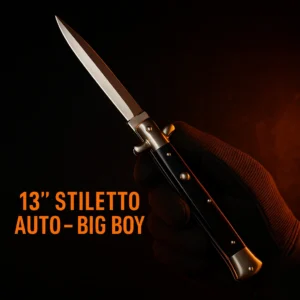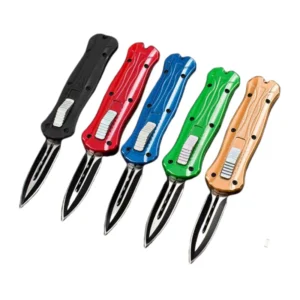


Why Are OTF Knives So Popular?

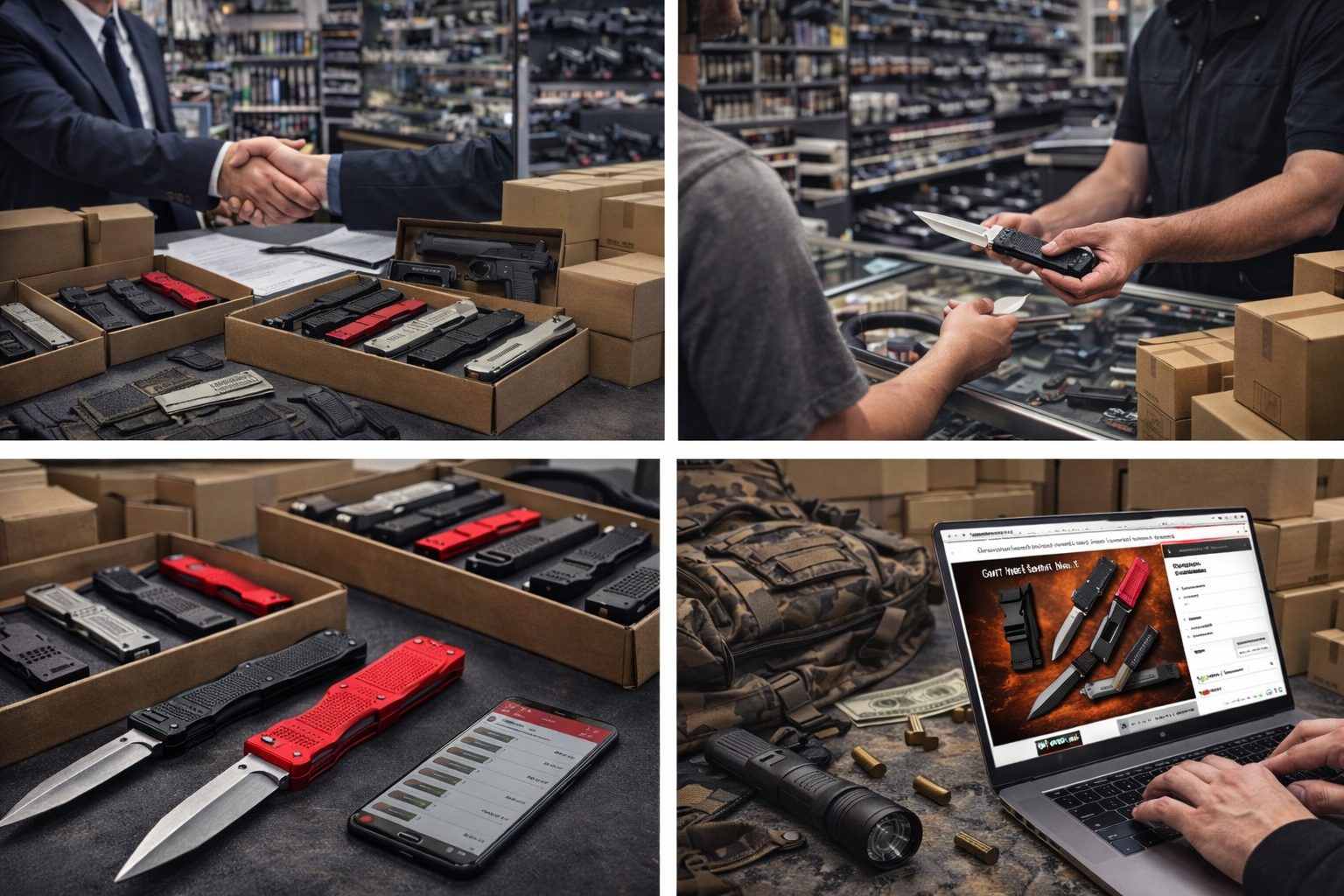
Short answer
OTF knives are popular because they open and close fast with one hand, carry flat in the pocket, and work well in tight, wet, or gloved conditions. Learn where
In this article
- 01 Why the OTF design feels better in real use
- 02 Where OTF knives actually outperform other knife types
- 03 Best for / worst for
- 04 Comparison lens: ergonomics, not hype
- 05 What users often misjudge about OTF knives
- 06 A practical checklist for choosing the right OTF
- 07 Why popularity stays strong despite the tradeoffs
- 08 Common questions about OTF popularity
- 09 Are OTF knives popular because they are faster?
- 10 Do OTF knives work well for everyday tasks?
- 11 Why do some users stop carrying OTF knives?
- 12 Are OTF knives better than folding knives?
Yes—OTF knives are popular because they solve a very specific problem better than many other knives: they let the user deploy and retract the blade quickly with one hand while keeping the cutting edge compact in pocket carry. Their popularity comes from speed, flat carry, and easy access in real conditions like gloves, wet hands, seatbelt cuts, tape work, and other tight-space tasks.
This page is different from general “what is an OTF” or self-defense pages because the focus here is not hype. The real reason people keep buying OTF knives is ergonomics: the handle shape, thumb-slide action, and in-line blade path make them feel fast and controlled in situations where a folding knife can be slower or more awkward to manipulate.
Why the OTF design feels better in real use
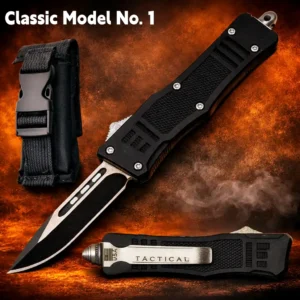
An out-the-front knife deploys by pushing a thumb slider forward, sending the blade straight out of the handle. That motion matters. It is simple, repeatable, and easy to do when the other hand is busy holding a box, steadying cord, moving plastic wrap, or bracing against a surface.
For many users, the appeal is not just speed. It is the combination of one-hand opening and one-hand closing. A standard folder may open quickly, but closing it often takes more finger repositioning. An OTF can often be retracted without bringing fingers near the edge, which feels cleaner and more controlled during repetitive cutting.
That is why OTF knives stay popular with people who value pocket carry convenience but still want immediate blade access. In jeans, work pants, or jacket pockets, the long, flat handle usually rides neatly and prints less like a bulky manual folder.
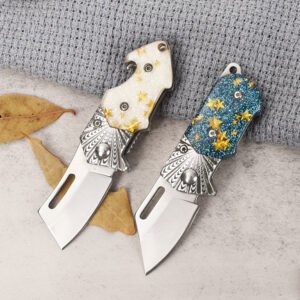
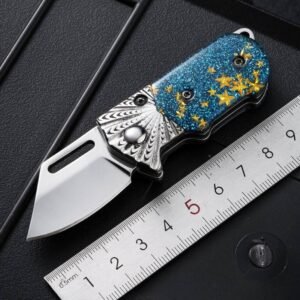
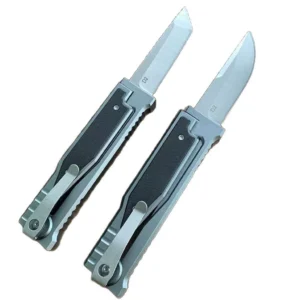
If you want to see current styles, blade shapes, and handle sizes, browse the OTF knife collection to compare what this format actually looks like across different use cases.
Where OTF knives actually outperform other knife types
OTF knives are most popular in environments where access and hand position matter more than raw cutting power. They are not the best answer for every task, but they are unusually strong in a few common scenarios.
- Tight-space cutting: Opening a blade while seated in a vehicle, standing on a ladder, or working in a narrow aisle is easier when the blade comes straight out the front.
- Gloved use: A large thumb slider is often easier to find and drive than a small thumb stud or nail nick.
- Wet hands: When palms are sweaty or wet, the gross motor action of pushing a slider can feel more certain than pinching a blade or manipulating a liner lock.
- Frequent short cuts: Cutting tape, shrink wrap, zip ties, plastic banding, or loose cord is where quick deploy-and-retract action becomes noticeable.
- Clean pocket carry: Many users like that the blade is fully enclosed in the handle when carried, with no exposed spine or partially open profile in the pocket.
That does not make an OTF automatically better than a folder or fixed blade. It means the OTF wins when the user values access under imperfect hand conditions.
Best for / worst for
- Best for: Pocket carry, opening boxes, cutting tape, trimming cord, emergency access in a vehicle, and users wearing gloves or working with one hand occupied.
- Worst for: Heavy twisting cuts, prying, digging into dense material, batoning, and dirty jobs where grit, drywall dust, or pocket lint will be ignored for months.
Comparison lens: ergonomics, not hype
If you want the shortest explanation for their popularity, it is this: OTF knives reduce hand gymnastics. That is a stronger reason than speed alone.
Compared with a side-opening automatic, an OTF often feels more neutral in the hand because the blade deploys in line with the handle. Compared with a manual folder, there is less dependence on a precise thumb angle, wrist motion, or lock release sequence. Compared with a fixed blade, it carries smaller and cleaner in daily pocket use.
Here is the practical winner-by-use-case view:
- Choose an OTF when one-hand access, quick retraction, and slim pocket carry matter most.
- Choose a manual folder when you expect dirt, lint, and rough treatment but still want compact carry.
- Choose a fixed blade when the job is hard, dirty, and forceful enough that deployment speed does not matter.
That is why OTF knives remain popular even among people who own other knife types. They are not replacing every knife. They are filling a comfort-and-access role that many users notice immediately.
What users often misjudge about OTF knives
The biggest mistake is assuming popularity means universal suitability. It does not. Buyers often overestimate what an OTF should do in dirty or abusive work.
An OTF has a mechanical track and internal firing system. That means pocket lint, grit, and fine debris matter more than they do on a simple fixed blade. If someone uses an OTF to cut tape all day in a clean stockroom, that is one environment. If they drop it into sand, drywall dust, or muddy truck floors and never clean it, that is another.
Another common misread is blade thickness versus cutting feel. Some people expect an OTF to behave like a heavy-duty utility knife just because it deploys dramatically. In reality, many OTF knives are better at controlled slicing than hard torque. Cutting cardboard, cord, clamshell packaging, and tape is different from twisting through thick rubber or scraping staples from wood.
Users also confuse carry convenience with task fit. A knife can carry beautifully in the pocket and still be the wrong tool for dirty demolition work. Popularity comes from how pleasant the knife is to carry and access, not from being the strongest tool in every category.
A practical checklist for choosing the right OTF
If you are deciding whether an OTF is popular for the right reasons in your own use, use this checklist. It keeps the decision tied to real conditions instead of impulse buying.
- Define the environment first. Is the knife going into a clean pocket, a dusty tool bag, a wet jacket, or a vehicle console? Clean and wet are easier environments for OTFs than dirty and gritty.
- List the actual cuts. Tape, plastic wrap, cord, food bags, seatbelts, and loose threads favor fast deployment. Thick hose, wood scraping, and prying do not.
- Think about your hands. Gloves, cold fingers, wet hands, and limited dexterity make the OTF slider more appealing.
- Check handle length in pocket carry. OTFs are often longer in the handle than folders with similar blade length. Make sure the pocket space works for your jeans, work pants, or jacket.
- Be honest about maintenance. If you never clear lint and never check for grit, choose accordingly. OTFs reward basic upkeep.
- Match blade shape to the job. A dagger profile may look striking, but many users doing tape and box work prefer a single-edge or drop-point style for more practical cutting contact.
This is the simplest test: if your daily use involves repeated short cuts, one occupied hand, and frequent pocket carry, an OTF often feels popular for very understandable reasons. If your work is dirty, forceful, and careless with tools, the appeal may fade quickly.
Why popularity stays strong despite the tradeoffs
OTF knives stay popular because the benefit is immediate. The first time someone opens one while wearing gloves, closes it one-handed after slicing tape, or retrieves it cleanly from a pocket in a cramped seat, the design makes sense.
That immediate payoff matters more than abstract specifications. People notice comfort, access, and carry every day. They only notice the limits when they ask the knife to do jobs it was not built for.
For users comparing everyday carry tools with emergency-minded products, it can also help to review related utility and self-defense products to separate practical cutting needs from personal protection expectations. That distinction prevents a lot of bad buying decisions.
In short, OTF knives are popular because they are easy to access, easy to close, and easy to carry in the kinds of real moments that frustrate other knife designs. Their popularity is earned most in clean-to-moderate environments, with gloves, wet hands, pocket carry, and frequent short cutting tasks.
Common questions about OTF popularity
Are OTF knives popular because they are faster?
Yes, but speed is only part of it. The bigger reason is that they are easier to operate with one hand from start to finish.
Do OTF knives work well for everyday tasks?
Yes, if those tasks are things like cutting tape, opening boxes, trimming cord, and making short controlled cuts. It depends if the work is dirty, gritty, or force-heavy.
Why do some users stop carrying OTF knives?
Usually because they chose one for the wrong environment. If a user expects pry-bar toughness or ignores lint and grit, the knife may feel less convenient over time.
Are OTF knives better than folding knives?
It depends on the use case. OTF knives are often better for one-hand access and pocket carry convenience, while folders can be simpler for rough, dirty, low-maintenance use.