

What Is the Most Popular Blade Style for an OTF Knife?

Short answer
Learn which blade style is most popular for OTF knives and why wholesale buyers, resellers, and serious users usually choose drop point over dagger, tanto, and
In this article
- 01 Why drop point leads in OTF knives
- 02 How drop point compares with other common OTF blade styles
- 03 Drop point vs dagger
- 04 Drop point vs tanto
- 05 Drop point vs spear point
- 06 What matters most when choosing blade style for OTF resale
- 07 A practical buying comparison for OTF blade styles
- 08 Common mistakes buyers make with OTF blade styles
- 09 FAQ
- 10 Is dagger the most recognizable OTF blade style?
- 11 Why is drop point more practical on an OTF?
- 12 Are tanto OTF knives popular?
- 13 What blade style should a retailer stock first in OTF knives?
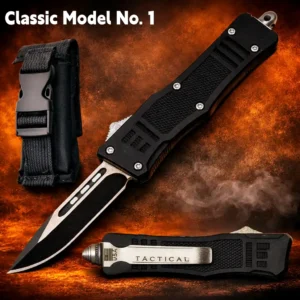
The most popular blade style for an OTF knife is the drop point. In real OTF buying, drop point wins because it handles the broadest mix of cutting tasks, looks familiar to retail customers, and creates fewer complaints than more specialized blade shapes.
That answer matters because OTF knives are bought differently from standard folders. Buyers do not judge blade style only by appearance; they judge how the blade fires through the handle, how safe the tip feels in daily carry, how easy the edge is to explain at the counter, and how often returns happen after customers actually use the knife. For most wholesale programs and serious retail assortments, drop point is the style that sells steadily without needing much education.
Why drop point leads in OTF knives
A drop point blade has a gently sloping spine and a practical tip. On an OTF, that shape solves several real-world problems at once.
- It cuts common materials well. Cardboard, plastic strapping, shrink wrap, tape, cord, and light utility work are all easier to manage with a belly that can slice cleanly.
- It feels less risky to average buyers. A dagger or aggressive tanto can look purpose-built for one role. A drop point reads as a general-use tool, which broadens the customer base.
- It is easier to sharpen and explain. Store staff and end users understand the edge shape quickly. That lowers friction at the point of sale.
- It balances tip control and durability. OTF users often fire and retract with one hand, then make short controlled cuts. Drop point geometry supports that kind of use better than highly specialized tips.
In short: drop point is the most popular because it is the easiest OTF blade style to live with every day.
This is especially true when buyers are choosing from a broad OTF knife collection intended for mixed retail demand. A style that works for warehouse staff, outdoor users, collectors, and first-time OTF buyers will usually outperform a blade shape that needs a long explanation.
How drop point compares with other common OTF blade styles
Popularity does not mean every other style is wrong. It means other styles are usually narrower in appeal.
Drop point vs dagger
Dagger blades are visually iconic in OTF knives. They look fast, symmetrical, and dramatic. That helps in collector-driven or self-defense-oriented displays, but they are less convenient for routine cutting because many dagger patterns have two sharpened edges or a reduced slicing belly. They also create more handling caution for casual users.
Normal: a buyer picks up a drop point OTF, fires it, inspects the edge, and immediately understands where and how to cut tape or open a box.
Warning sign: a buyer picks up a dagger OTF, asks whether both edges are sharpened, hesitates about pocket carry, then puts it back because it feels too specialized.
Drop point vs tanto
Tanto blades attract buyers who want a stronger-looking tip and a tactical appearance. On an OTF, however, the secondary angle can be less forgiving in long slicing cuts. Tantos can perform well in puncture-heavy tasks, but many retail customers are not buying an OTF for repeated piercing work. They are opening packages, cutting cord, and carrying the knife daily.
A common failure mode here is overestimating visual appeal. A reseller may stock mostly tantos because they look aggressive in photos, then find that in-store buyers prefer the blade they can picture using immediately.
Drop point vs spear point
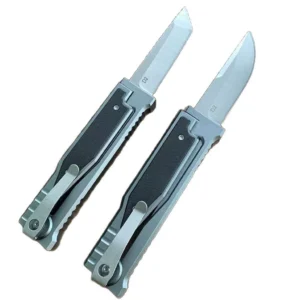
Spear point blades are common on OTFs because the centered tip suits the straight-line deployment of the mechanism. They often look clean and balanced. Still, many spear points in the market lean closer to tactical styling than utility styling. Drop point usually has more obvious belly and a friendlier profile for daily cutting.
If your customers are asking for one blade that covers work use and personal carry, drop point usually has the edge. If they want a classic OTF silhouette first and utility second, spear point may compete more strongly.
What matters most when choosing blade style for OTF resale
Blade style on an OTF should be judged by what happens after the knife leaves the display case. The key question is not which shape looks best under bright light. It is which shape still makes sense after a week of firing, retracting, and cutting ordinary materials.
- Task range
Inspect what your customers actually cut. If the answer is shipping materials, light rope, food packaging, and daily utility, drop point is usually the safest bet.
- Customer confidence
Compare how quickly a new buyer understands the blade. If they need less explanation and show less hesitation, that style will usually convert better.
- Tip behavior in an OTF format
Because OTF knives deploy straight out the front, users notice tip shape immediately. A practical tip that does not feel overly fragile or overly aggressive tends to get better feedback.
- Return and complaint risk
Cycle samples, inspect the grinds, and look at how the edge line meets the tip. A flashy shape can attract attention, but if buyers later report awkward cutting or carry discomfort, the initial appeal does not help much.
This is where OTF knives differ from many side-opening knives. On a standard folder, some buyers will tolerate a more specialized blade because opening and closing feel familiar. On an OTF, the mechanism itself is already a feature. That means the blade style often needs to reduce complexity, not add more of it.
A practical buying comparison for OTF blade styles
Use this quick inspection flow when comparing styles side by side.
- Fire the knife: Does the blade shape look stable and easy to orient the moment it locks out?
- Retract it: Does the user seem comfortable operating it without overthinking exposed edges?
- Wiggle the blade lightly: Minor play is common in OTFs, but inspect whether the blade style makes that movement feel more noticeable or less confidence-inspiring.
- Inspect the edge profile: Is there enough usable belly for slicing, or is the shape mostly optimized for tip-forward presentation?
- Compare sales-floor explanation time: Which blade can staff describe in one sentence?
- Cycle multiple units: See whether the style still feels practical after repeated deployment, not just exciting on first impression.
A concrete example: imagine a retailer stocking three OTF styles in equal quantities—drop point, dagger, and tanto. The dagger gets the most comments. The tanto gets the most photo attention. The drop point gets the most repeat purchases from customers who come back and say, “I actually use this one.” For a commercial assortment, that is usually the signal that matters.
For buyers serving customers who also shop broader utility and self-defense products, it is smart to separate “looks tactical” from “works daily.” Those are not always the same sale.
Common mistakes buyers make with OTF blade styles
- Choosing only by silhouette. OTF knives photograph well, but the best-selling shape is often the one that feels least confusing in hand.
- Assuming the iconic style is the most useful. Dagger profiles are strongly associated with OTF knives, yet that does not make them the broadest seller.
- Ignoring sharpening reality. Some blade styles ask more from the end user. If your customer base wants easy maintenance, that matters.
- Overlooking first-time OTF buyers. Many buyers want the mechanism to be the novelty and the blade to be familiar. Drop point fits that pattern well.
- Failing to inspect tip-to-task fit. A tip that looks dramatic may be less comfortable for package opening and daily carry.
FAQ
Is dagger the most recognizable OTF blade style?
Yes, dagger is often the most recognizable visually, but it is not usually the most popular for broad everyday use. Drop point tends to sell better across mixed customer groups.
Why is drop point more practical on an OTF?
It gives users a clear cutting edge, a controllable tip, and better slicing belly for common tasks. That makes the OTF mechanism feel more useful rather than more specialized.
Are tanto OTF knives popular?
Yes, especially with buyers who want a tactical look and a stronger tip profile. They are popular, but usually not as universally accepted as drop point.
What blade style should a retailer stock first in OTF knives?
If the goal is the widest appeal, start with drop point. It is the easiest style to demonstrate, explain, and sell for ordinary carry and utility use.